





A PALE VIEW OF THE HILLS
MOVIE REVIEWS
TÔI YAMA-NAMI NO HIKARI
A pale view of the hills: written by Giannis Fragoulis
Table Of Content
Etsuko is soft-spoken and reserved in her emotional expressions, a trait that frustrates Niki, who was born in England a few years later when her mother met a British man and moved to Europe with him. Faced with decisions regarding her own future, Niki feels that many events in her family’s past have been left in the dark and is determined to press her mother to reveal the truth.
A pale view of the hills: The plot
The core subject of the film is the conversation between Niki and Etsuko. Mother and daughter discuss the events that took place in Nagasaki. Etsuko was living near Nagasaki when the atomic bomb -dubbed «Fat Man»- was dropped, whereas «Little Boy» fell on Hiroshima. The trauma of the atomic explosion and the mass murder of hundreds of Japanese people has not yet healed. Kei Ishikawa aims to present a different version of what could be called a collective trauma in the Japanese consciousness. From 1999, when he directed a short film, up until 2025, he has made numerous shorts and video productions, and completed seven feature films, including the one discussed here. Film critics in Japan awarded the film in 2025.
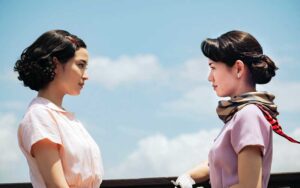
Niki has no firsthand knowledge of Japan, let alone Nagasaki. She is a London-based journalist and author who needs to write about Nagasaki because «it is in fashion right now», as her publisher’s representative tells her. Her mother is her sole source of information. The house she was born in and used to live in is about to be sold, offering her a chance to search for photographs and various documents, such as letters. She does so, yet her mother remains her main source. Hesitant at first, Etsuko eventually opens up and shares her memories. The central question is why this hesitation exists in the first place. The film does not answer this directly; the viewer is left to discover it.
A pale view of the hills: The trauma
Initially, we see what life was like in Nagasaki following the atomic bombing. The director explicitly shows the racism faced by those affected by radiation. More importantly, he highlights the reaction of those targeted by these racist attacks. The target of the attack is a young girl, and the one who reacts is her mother. In this manner, the director and co-screenwriter defines trauma.
At first, the traumatic situations are personal. In a Japan attempting to rebuild while under American occupation, everything appears to run smoothly. Life is strictly organized, people seem happy, and the future ahead looks promising. Yet, this is merely the facade of a divided nation. On one side are the young, who recognize the fault of the previous generation; on the other are the elders, who believe they did what was necessary and that the war was not lost through any fault of their own. These two distinct viewpoints stain a country that insists on submitting to an emperor viewed as a deity, a concept that the younger generation has begun to question.
A pale view of the hills: The new generation
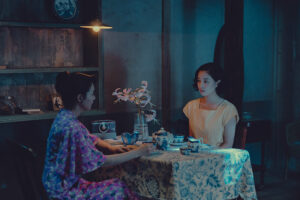
Within this younger generation, there are those who reject the blanket dismissal of traditional values. We see this in Etsuko, who lives a mostly traditional life. As she witnesses a conflict between a professor and her father-in-law, she stands stunned, unable to react. Something breaks inside her, which is perhaps what ultimately drives her to England. The outcome of this clash of values is the suicide of her first daughter, born in Japan. We say «perhaps» because the film leaves it ambiguous, merely highlighting Etsuko’s overwhelming guilt.
The present and the past coexist, either through references or the mother’s memories. In this way, the viewer enters the essence of the matter, accepts the director’s invitation, and becomes capable of forming their own opinion. Kei Ishikawa «paints» his own vision of Japan-a era he did not live through himself, having been born in 1977- offering an image filtered through his own beliefs. The Western element is strong, both as an occupying force and as a Western way of life in England. The film portrays the shift in the generation that followed the atomic bomb, as well as the subsequent one that embraced Western cultural values. Ultimately, the judgment is left to the viewer.
A pale view of the hills: The direction
The cinematography is remarkably simple, reminiscent more of Mizoguchi and less of Ozu. The slow pace allows the audience to digest the cinematic narrative and fully comprehend it. The musical score highlights emotion and, at key moments, builds emotional resonance, narrating events and giving them added narrative weight. The actors deliver strong performances, immersing themselves in their characters and evolving alongside the script’s progression.
A PALE VIEW OF THE HILLS
(TÔI YAMA-NAMI NO HIKARI)
Director: Kei Ishikawa
Screenplay: Kei Ishikawa, Kazuo Ishiguro (novel)
Cast: Suzu Hirose (Etsuko), Fumi Nikaidô (Sachiko), Yoh Yoshida (Etsuko in 1980), Camilla Aiko (Niki), Kôhei Matsushita (Juro), Tomokazu Miura (Ogata), Rie Shibata (Fujiwara), Daichi Watanabe (Matsuda), Mio Suzuki (Mariko)
Cinematography: Piotr Niemyjski
Editing: Kei Ishikawa
Music: Pawel Mykietyn
Sound: Takeshi Ogawa, Yoshio Nakamura
Production design: Hannah Spice
Costume design: Matthew Price, Sayaka Takahashi
Visual effects: Vitaly Bahel, Mahesh Gadakh, Lukasz Grzelak, Szymon Kania
Special effects: Steve Bowman
Producers: Miyuki Fukuma, Marta Gmosinska, Hiroyuki Ishiguro, Elizabeth Karlsen, Mariusz Wlodarski, Stephen Woolley
Country of origin: Japan, England, Singapore, Poland
Year of production: 2025
Genre: Tragedy, Historical
Language: English, Japanese
Color: Color
Runtime: 123 min
For more information regarding the cast, crew, and technical details of the film, see here.