
KAPODISTRIAS
MOVIE REVIEWS
A MISGUIDED PORTRAIT
Kapodistrias: written by Giannis Fragkoulis
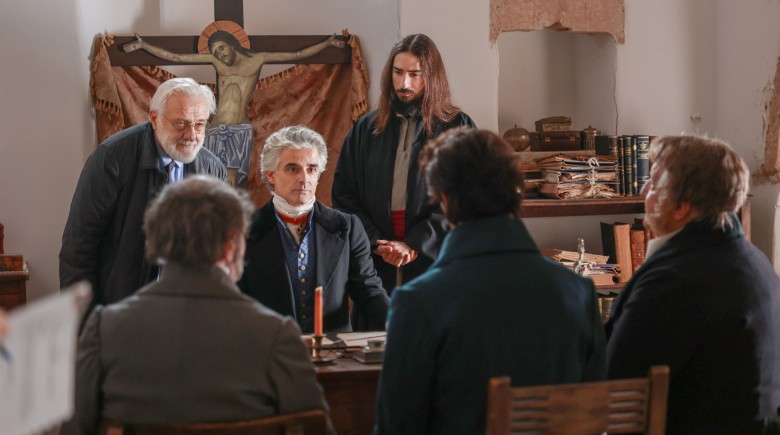
The film «Kapodistrias» is a historical drama set in the early 19th century and tells the true story of the greatest Greek statesman and first governor of Greece, Ioannis Kapodistrias, after the country’s liberation from the Ottomans. He defends the freedom of every human being with courage, kindness, and dignity, sacrificing even the great love of his life, and does not hesitate to confront the forces of evil, giving up wealth, glory, and international recognition.
Kapodistrias: The film
When Greece gains its freedom, Kapodistrias is called to become its first governor. Although he senses that he will be assassinated, he accepts his fate without complaint and sacrifices himself, serving his homeland with faith and devotion. This sacrifice leads him to true freedom.
We watched the film in the small Pavlos Zannas hall in Thessaloniki, and we can now talk about what this work offered us. The job of a film critic is sometimes very painful. I’m referring to the challenge of writing about a Greek film and being obliged—because you respect yourself—to express what you truly gained from it. Since 1996, Yiannis Smaragdis has, one could say, specialized in portrait films: «Cavafy» (1996), «Spyros Louis» (2004), «El Greco» (2007), «God Loves Caviar» (2012), «Kazantzakis» (2017), «Report to Ioannis Kapodistrias» (2021), «Kapodistrias» (2025).
Kapodistrias: The «true» story
Let’s take things one step at a time. It is stated that the film tells the true story of Kapodistrias. This word «true» creates a problem for us. How can a fictional film be a true story? Even a documentary does not fully correspond to what we call reality. Besides, what the screenwriter and the director consider real is certainly not a faithful rendering of what, objectively, would be the real. Every film, according to film theory, is a construction created by its makers and not a true story in the sense of historical record.
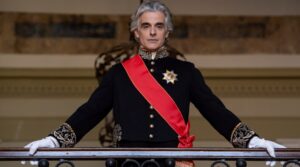
The first problem with the film is its ideological stance. Kapodistrias was a count, a favorite of the Tsar, a diplomat, and the foreign minister of Tsarist Russia. It is obvious that he was an instrument of the political elite that governed Europe at the time. What was his position regarding the Revolution of 1821? To Galatis, who spoke to him about the preparation of the uprising, he said the following:
Kapodistrias: The dialogue
«For anyone to even think of such a plan, he must be mad. And for someone to dare speak to me about it in this house, where I have the honor of serving a great and mighty emperor, he must be a young man who has just emerged from the rocks of Ithaca (editor’s note: Galatis was from Ithaca), or someone who has been carried away, I know not by what blind passions. I cannot speak with you any further about the purpose of your mission, and I inform you that I will never read your papers. The only advice I can give you is to say nothing to anyone about this, and without delaying even for an hour, to return and tell your superiors that if they do not wish to perish themselves and destroy along with them their innocent and unfortunate nation, they must abandon their revolutionary machinations and continue to live as before under the governments they are currently under, until divine providence decrees otherwise.» (Kokkinos, vol. 1, p. 136). This was his response to the Filiki Etaireia member who asked him for help—help he could have offered as the foreign minister of Tsarist Russia.
Kapodistrias: Politics
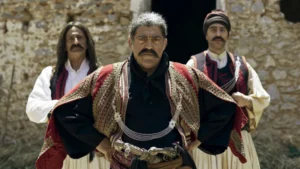
What truth does the film claim to tell? It presents a revolutionary politician, whereas Kapodistrias was nothing more than a conservative statesman, a servant of the Tsar. Moreover, in the film the kotzabasides are depicted as bandits. In reality, they were local notables who had grown wealthy from the toil of the Greeks through their collaboration with the Ottoman conquerors. The Greek people are portrayed as miserable and frightened—yet these were the very people who had carried out the second great revolution after the French one, and who had not yet laid down their arms. The film’s narrative stands in complete contrast to what historical accounts describe (Paparrigopoulos, Kokkinos, Fotiadis, Skarimbas). And finally, there is no reference whatsoever to the essential character of the 1821 Revolution, which was class-based, as Skarimbas makes clear.

Kapodistrias: The screenplay
Essentially, the screenplay is full of historical inaccuracies. This is not a problem if one is creating a free interpretation of the historical record, but not a «true story», as the production claims. When the script is not what it should be (for a «true» story), it becomes obvious that what you cannot achieve is an accurate analysis of the characters and, consequently, their proper construction. As a result, the characters end up as caricatures, as they do in this film—caricatures one might find in a poorly made comic book.
The only character with a somewhat respectable construction is that of Kapodistrias himself, though even he is portrayed with major inaccuracies and significant omissions. This is why the dialogues resemble those found in a cheap television production. To give these characters a sense of grandeur, the film relies on lavish sets and beautiful costumes, which, however, cannot save the situation. What we see are characters who add nothing to the narrative weight as the story unfolds. They remain unchanged, like comic‑book figures, and therefore lack the cinematic structure one would expect.
Kapodistrias: The old method
As we said, the directorial choices are far removed from the historical record. Let us, however, focus on the actors’ movements and their placement within the space. Some impressive panoramic shots add a sense of grandeur. But when the actors move, stand, and speak, we can discern the old method once used in theatre and later in television forty years ago. The direction has nothing to do with cinema as the art form has evolved since it became the seventh art. Unfortunately, in this large‑scale production, artistic direction is absent. A very simple comparison with films from 1960 onward is enough to convince us that Smaragdis’ cinema is not about artistry but about the management of images.
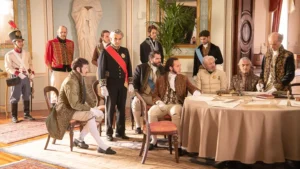
Let us return to the characters. The structure of the screenplay is filled with conservative positions, friendly toward the official Church; thus, what we have is a hagiography of Ioannis Kapodistrias which, two hundred years later, is not at all necessary—especially at a time when more and more studies are being published about the nature of the Revolution, its protagonists, and their relationship to those who govern today. In fact, Kapodistrias is given the character of Christ, and here we encounter clear exaggeration. And this brings us to the crucial issue.
Kapodistrias: The editing
As for the cinematography, we noticed several shortcomings -shots that were overexposed, both in the exterior and interior scenes. The use of special filters to reduce light, the narrowing of the aperture, and the necessary reflectors were simply absent. Aris Stavrou did not pay the attention he should have to his framing. On the other hand, the editing created a good rhythm; shots faded out and came in from one sequence to the next with great precision, allowing for smooth transitions and avoiding any jumps.
The reports claimed that the film had been treated unfairly in terms of funding. Yet in the credits we saw that it was financed by the Ministry of Culture, so what injustice are we talking about? It becomes clear that all these orchestrated reports were nothing more than an excellent promotional trick. Many years ago, Yiannis Smaragdis told a female director at the Larissa Festival that films are made with love, after hearing about the difficulties in production. Indeed, Smaragdis makes his films with love—for his financial profit and his own promotion.
Kapodistrias: The knowledge
If he wants to create noteworthy portrait films, it would be good for him to study the work of Lila Kourkoulakou on Venizelos, Lakis Papastathis on Theofilos, the referential films of Takis Kanellopoulos, the work of Kostas Ferris on Fragkoyannou, and that of Yiannis Charalampopoulos on Cavafy and Pessoa, to name a few. Then he should study foreign productions as well, and with what he learns, we can hope he will one day create a truly cinematic biographical narrative about a historical figure. Because everything he has done so far—with Cavafy being something of an exception—has been at the very least misguided.
KAPODISTRIAS
Director: Yiannis Smaragdis
Screenplay: Yiannis Smaragdis
Cinematography: Aris Stavrou
Editing: Stella Filippopoulou
Music: Minos Matsas
Sound: Giorgos Alexandropoulos, Iason Theofanou
Costumes: Michalis Sdougos
Art direction: Spyros Papatheodorou, Octav Tudor
Producers: Gabriel Popescu, Yiannis Smaragdis
Cast: Antonis Myriagos (Kapodistrias), Finbar Lynch (Klemens von Metternich), Tasos Chalkias (Prime Minister Spiliadis), Maximos Moumouris (Kolokotronis), Nikorestis Chaniotakis (Nikodimos), Ilektra Fragkiadaki (Roxandra), Dimitris Georgiadis (Tsar Alexander), Natalia Kapodistria (immaterial figure of the Virgin Mary), Mary Vidali (Manto Mavrogenous), Pavlos Kontogiannidis (Kountouriotis)
Country of production: Greece
Year of production: 2025
Color: Color
Genre: biography, history
Duration: 129 minutes
Distributor: Tanweer
Release date: 25/12/2025 (Greece)
More about the film’s contributors and technical specifications here.
Read the film reviews we have published.




Στην ίδια κατηγορία













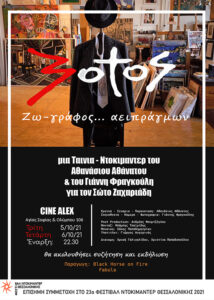
Δείτε το τρέιλερ της ταινίας μας, που συμμετέχει το Φεστιβάλ Ντοκιμαντέρ Θεσσαλονίκης.
SOTOS, EVERLASTING PAINTER (TRAILER)
Επικοινωνήστε
ΓΙΑΝΝΗΣ ΦΡΑΓΚΟΥΛΗΣ
Email: info@filmandtheater.gr
Τηλ: (+30) 6974123481
Διεύθυνση: Ιωαννίνων 2, 56430, Σταυρούπολη Θεσσαλονίκη