
WING A CELL 71
THEATRE REVIEWS
ON CONFINEMENT
Wing A cell 71: written by Giannis Fragkoulis
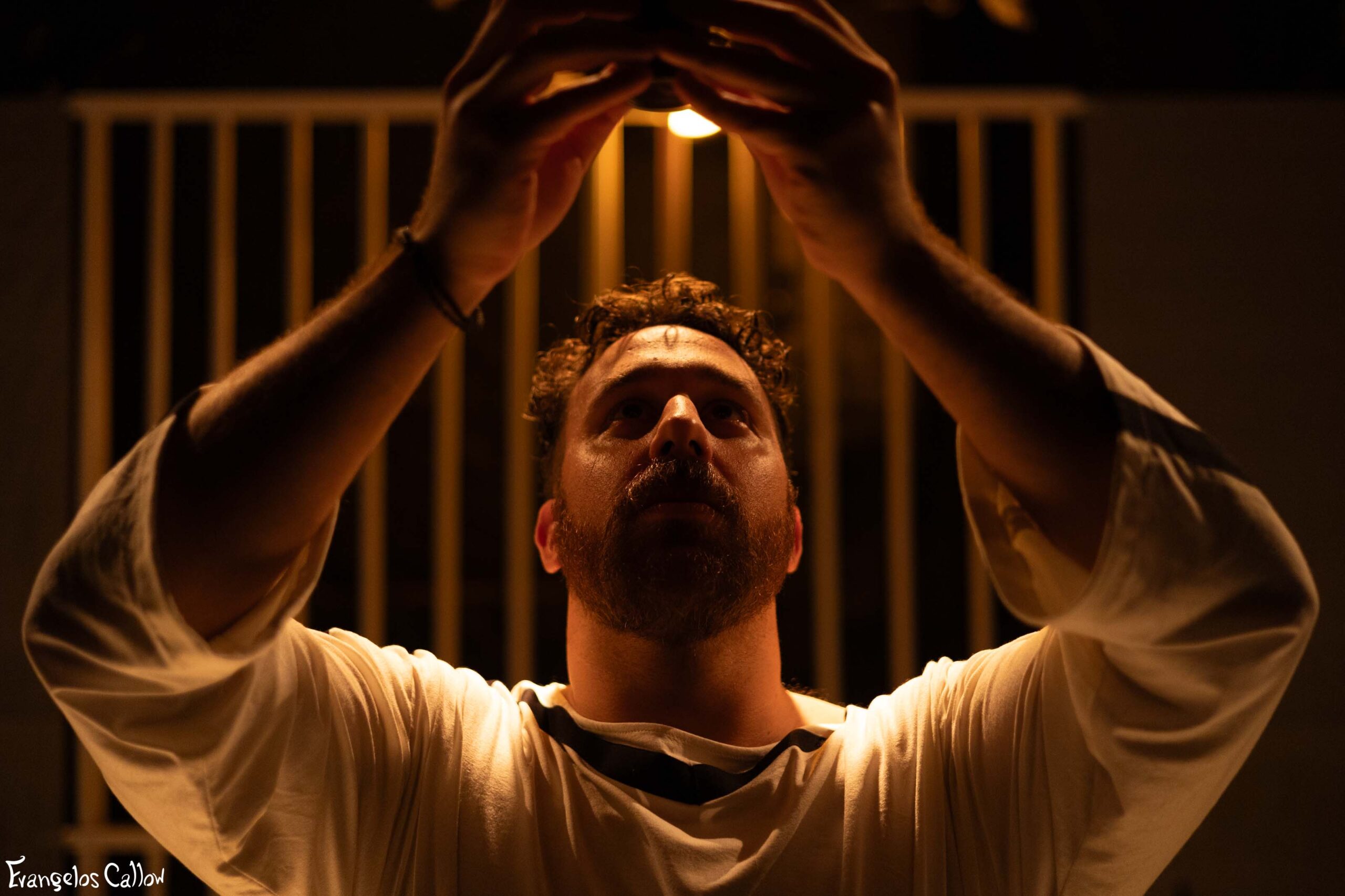
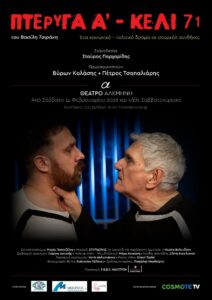
We had referred in our book review to Vasilis Tsirakis’ novel Wing A, Cell 71. It is a novel written in the form of a theatrical play. The time has come for it to be staged, and it premiered on 14 February 2026 at Alkmini Theatre, in the Secret Room stage, in Athens. We hope this production will also be presented in Thessaloniki, as it is particularly significant in its exploration of the concepts of confinement and freedom, which we will discuss in this critical note. The direction is by Stavros Parcharidis.
Wing A cell 71: The play
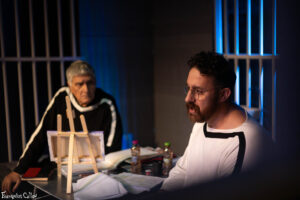
The story unfolds inside a single cell. Two inmates convicted of homicide attempt to coexist. At first, the older prisoner views the younger one with hostility, as he is a migrant who «struck the hand that helped him». Over time, however, they find common ground, and eventually each begins to care for the other. Their only contact with the outside world is a small radio broadcasting the news headlines. The guard’s voice is their sole communication with the world of the free. The routines of prison life -the cell, reading, painting, jogging, the library, and interactions with other inmates- are sometimes shown to the audience and sometimes implied. What we see is only what happens inside this cell.
The older inmate is, at first, fierce. He intimidates and threatens his cellmate, saying he will kill him if he does not obey. As time passes, however, he begins to step into the role of the prisoner who has come from the neighboring country. He wants to learn his story, and the younger inmate wants to know what brought him to Cell 71. A whole world unfolds before us, and the concepts of freedom and safety are put to the test.
Wing A cell 71: The two stories
The surprising element is that the younger inmate actually feels content in prison. He has everything he once dreamed of: time, shelter, heating, and food. His life in his home country had been unbearable. When he arrived here, he worked for an employer who was murdered by a young refugee because he owed him money. After thinking it over, he wiped the fingerprints off the knife, placed his own on it, and called the police. It was not a judicial error but a deliberate choice -he wanted to go to prison.
The older inmate had lived a fast-paced life, full of competition and with no free time. He worked as an architect and painted. The way his life was structured had made him forget how to even hold a paintbrush. Someone killed his boss, and his fingerprints were found on the paper knife. Now, in prison, he has his own library and paints again.
In these two stories we see the concepts of freedom and confinement explored in an experiential way. In prison, they are confined. In their lives, when they were free, did they possess the kind of freedom a person seeks? According to their own accounts, the answer is no. What, then, is the difference between prison and life outside? This is the question both men are searching for, and perhaps one they will never truly answer.
Wing A cell 71: The freedom
What does «freedom» mean? Marx defined it as the awareness of the limits of one’s own possibilities. The classical definition states that freedom exists when a person can do what they desire. But within the word “desire” lies a major issue. A person’s desire to do something is shaped by many factors, not all of which originate in their inner psychological or ideological world. Many of these factors are concepts that come from the society in which we live and are, in some way, imposed upon us. They enter our value system unconsciously. A classic example is the consumerist way of life, which often appears—and indeed is—excessive and irrational, without us even realizing it.
Consequently, the concept of freedom is relative and shifts according to the value changes within society. This observation runs throughout Vasilis Tsirakis’ book. Naturally, the play represents only a part of the novel, adapted so it can fit within theatrical time. The exploration of the meaning of freedom remains present, in both the book and the play, until the very end.
Let us now turn to the concept of safety. Is a person truly safe in our society? If we investigate the fear we feel for our own safety in everyday life -something that often leads to xenophobia- then we have made no real progress in this search. Safety has more to do with our own fears and inhibitions than with the possibility of being attacked by someone. For if we truly know ourselves, then we possess defenses strong enough to repel an attack. But do we know ourselves?
Wing A cell 71: The world
The entire philosophical tradition of ancient Greece, of the Eastern world, and of later philosophical schools revolves around this very question. Do we know ourselves, and if not, how can we come to know who we are? Answers exist, written in books we can read. Yet this knowledge is not offered to the modern Western individual, who -accustomed to a frenetic way of life- consciously refuses to read, to become informed, and to reflect. The book that the older inmate gives to his cellmate transforms the latter’s life completely. He becomes absorbed in its ideas and begins to see the world with new eyes.
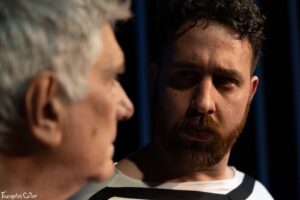
He now has enough resources to defend himself against the attacks he may face in the social environment. The little radio describes a world that is bleak: unemployment is rising, a war is about to break out and eventually does, the need for soldiers becomes urgent, and they end up conscripting the inmates. The prisoner who now possesses the tools for self‑defense decides he wants to test his strength in society, to taste life; in the end, he will enlist in the army, and thus the remainder of his sentence will be pardoned. It is worth noting that the theme of enjoyment -an essential element for understanding reality- is symbolized by the violin. First, the younger inmate plays it, performing a mournful tune as if lamenting the loss of his freedom, and then the older one plays it too, creating the suggestion that the two men are becoming identified with one another, as if they were one and the same person.
Wing A cell 71: The oppression
At this point, a conflict erupts. The older inmate is free to leave because the murderer of his boss has been found. Yet he fears unemployment, insecurity, and the inhuman pace of life in the free world. He decides to declare that he himself killed his boss. He is afraid. His fear concerns both his freedom and the demands of a society that is hostile to the individual. He is afraid to struggle to change the world and to stand alongside his fellow citizens. He remains in prison. This hysterical state is projected onto his cellmate. The younger inmate understands this and accuses him. He leaves.
Despair now settles within the older inmate. He will no longer have someone to lecture, someone before whom he can appear knowledgeable, someone who confirms his sense of importance. He is ready to commit suicide. If we look more closely at this man, we see that prison represents freedom and safety for him. Oppressed by his mother and father, pressured by the professional world in which he lived, prison becomes something like a return to the womb -a place of safety and pleasure, where hysteria dissolves and, within this cocoon, he finally feels secure. This, too, is a kind of solution. All he wants is someone who will affirm his identity. That someone is the inmate who has now left. This separation is his symbolic castration, and it drives him toward the desire to die.
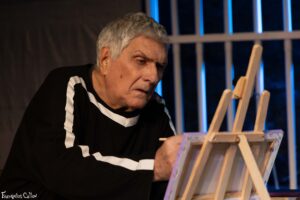
Wing A cell 71: Characteristics
Vasilis Tsirakis poses the following question: Is it worth trying one’s strength and attempting, even slightly, to change the world? Naturally, he lets the text imply the answer. In the performance, this is expressed through the hesitant gesture of suicide and through the courage of the other inmate. The change in the theatrical adaptation is that all of this turns out to be part of an experiment, reminiscent of what we have seen in the film Cube. In this production, the conclusion must be formulated by the spectator in their own metatext, once the performance ends, as they respond to the questions they themselves are prompted to ask.
An exceptional performance. The direction attends to even the smallest detail. The actors have been thoroughly coached and ultimately perform their roles with surgical precision. Their changes are subtle, yet as narrative time unfolds, we witness two entirely different individuals, and therefore two different value systems. The set is very simple—a small cell with only the bare essentials. The sound design marks the passage of time and the transformation of space, as the cell shifts in its function as a reservoir of stimuli. The costumes are simple, everyday, entirely realistic. In the end, the emotional impact arises effortlessly from the clash of values, without being forced upon the audience. It should also be noted that the characters, the space, and the countries remain unspecified, allowing for any interpretation.
WING A CELL 71
Author: Vasilis Tsirakis
Director: Stavros Parcharidis
Music: Spyridonas
Song performance: Marina Voloudaki
Set design: Maria Papatzelou
Costumes: Maria Papatzelou
Actors: Vyron Kolasis, Petros Tsapaliaris, Stavros Parcharidis (voice of the guard)
Lighting design: Giorgos Danesis
Assistant director: Eleni Kataliakou
Make-up artist: Maro Kokkoni
Costume construction: Vania Aleksandrova
Promo video: Gianni Tselini
Promo video & photography: Evangelos Kallou
Poster design: Paschalis Moudouris
Social media: Maridimi Papadopoulou
Production: E.TH.V.E. Maiotron
Theatre: Alkmini, Secret Room
Address: 8–12 Alkminis Street, Athens, Kato Petralona
Tickets: 12 euros (presale), 15 euros general admission, 10 euros group bookings
Duration: 70 minutes (no intermission)
Premiere: 14/2/2026.
Read the theatre reviews we have published (theatre reviews)
Σχετικά άρθρα
Στην ίδια κατηγορία















Δείτε το τρέιλερ της ταινίας μας, που συμμετέχει το Φεστιβάλ Ντοκιμαντέρ Θεσσαλονίκης.
SOTOS, EVERLASTING PAINTER (TRAILER)
Επικοινωνήστε
ΓΙΑΝΝΗΣ ΦΡΑΓΚΟΥΛΗΣ
Email: info@filmandtheater.gr
Τηλ: (+30) 6974123481
Διεύθυνση: Ιωαννίνων 2, 56430, Σταυρούπολη Θεσσαλονίκη