
THE SECRET AGENT
MOVIE REVIEWS
O AGENTE SECRETO
VIOLENCE UNDER THE BRAZILIAN DICTATORSHIP
O agente secreto: by Giannis Fragkoulis
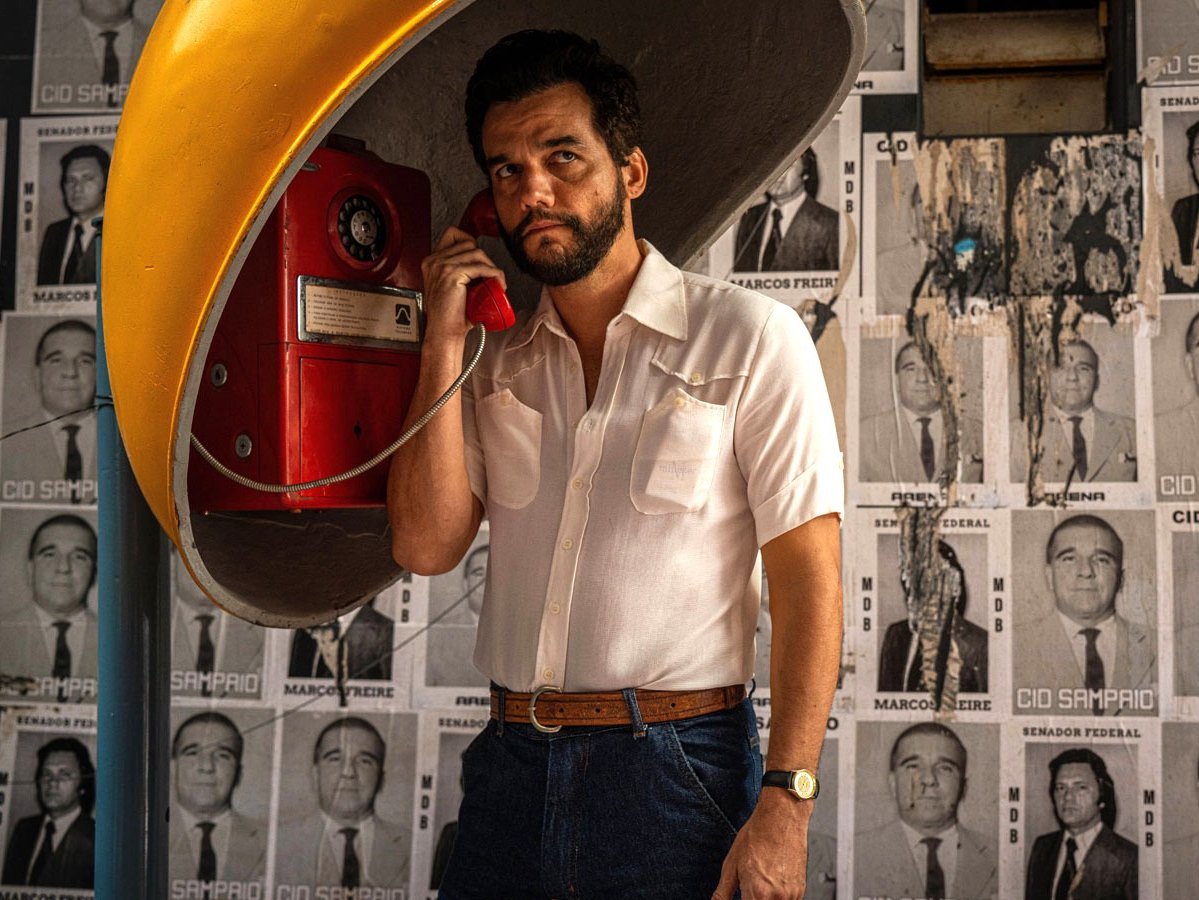
Brazil, 1977. The military junta is in power and corruption overflows across the social and political landscape. The disappearances of dissidents are frequent—and often horrifying. The heat and the carnival blur both body and mind. Marcelo is a handsome scientist who has caught the attention of the regime’s officials, spurred on by a powerful industrialist. His partner has «mysteriously» vanished, and his own life is now in danger. He returns to his hometown determined to find his son and flee the country. But will he make it in time, or will the would‑be executioners block his path?
O agente secreto: The movie
Kleber Mendonça Filho has crafted a film that has already won the Best Director award at the Cannes Film Festival, triumphed at the Golden Globes, and now looks toward the Oscars with optimism. His previous films, «Bacurau» (2019) and «Aquarius» (2016), followed a similar trajectory.
The film unfolds through two parallel narratives: Marcelo’s journey to the city where his son lives, as he tries to hide and escape abroad, and the present‑day investigation into those same events. A third thread also emerges—what happened during the industrialist’s visit to the university, where Marcelo was the director of the engineering lab, and the clashes between him and Marcelo’s partner when they realized the intention was to shut the lab down.
O agente secreto: The narratives
What is presented here is the historical event itself and its underlying causes. We are shown just one case among the hundreds that occurred during the Brazilian dictatorship. It is, therefore, a reference point from that era—something that could well be the subject of study for a research group, perhaps an academic one, seeking to examine the political conditions that prevailed under the junta.
The intertwining of the two main narrative threads is so skillfully done that, at first, the viewer becomes disoriented by what is happening. But the director quickly provides the keys needed to navigate the narrative landscape as he and the screenwriter -who are one and the same- have designed it, dispelling any confusion.
Marcelo is not portrayed as an idealized figure. He is a man with weaknesses, impulses, and an emotional world pulled between his son, his political involvement, and his own anxieties. This is not a hagiography but a portrait of a man who represents one of the thousands who were persecuted or killed during the dictatorship.
O agente secreto: The society
Thus, we are given a depiction of society at that time and a reflection on contemporary Brazil. It is a beautiful and productive way to draw our own conclusions. As the narrative unfolds, the director allows the viewer to form an opinion about today’s political landscape. We enter the narrative space, becoming Marcelo ourselves, living his life with one «small» difference: we transpose the social context of that era into the present day, shifting the social text into the political. This is achieved in a simple, effective, and experiential manner.
Realism coexists with the dreamlike in this film. We see elements of the surreal during Marcelo’s journey; in this way, his desires and anxieties are given visual form. As he approaches his destination, we encounter a corpse left by the police to decompose, with dogs trying to eat it. This immediately draws us into the narrative of a society in decay -something we will witness even more intensely as the story unfolds.
O agente secreto: The discovery
Soon after, we come across a macabre discovery: a human foot inside the belly of a shark caught by fishermen. To whom does this foot belong? The answer is simple -another victim of the junta’s paramilitary forces, thrown into the sea and turned into the shark’s food. This fragment of a human being becomes a living witness to the horrors of the era, and it must disappear so that no trace remains. They return it to the sea.
The coexistence of the realistic and the dreamlike opens a doorway into the realm of critical reflection. The viewer is given all the elements needed to judge what is happening in brazilian society today. The director reinforces this through the visit of a young woman from the research team to the hospital built on the site of the cinema once owned by Marcelo’s father‑in‑law and the grandfather of his son, who now works there as a doctor. She hands him a USB stick containing material from the case -videos, photographs, and documents- telling him that the research process has concluded because it was «determined» that the investigation contains personal information that cannot be disclosed.
O agente secreto: An example
Marcelo’s son finally has the chance to learn who his father is. He knows nothing about either of his parents, as he was very young when all of this happened. In a sense, he is fortunate regarding his father, because Marcelo never managed to find any trace of the boy’s mother, whom he never knew. Together with Marcelo’s son, we discover both the world of that era and contemporary Brazilian society, with a more penetrating gaze that allows us to see what lies behind statements and actions familiar from current events.
At this point, the social landscape of Brazil breaks its boundaries; Brazil becomes any country where similar conditions -whether to a greater or lesser degree- restrict human aspirations, where respect for the human being is absent, and oppression becomes the dominant mode of behavior.
A particularly striking element is the hitman who comes from the lumpen proletariat. He is a porter, working hard just to make a living. He agrees to kill Marcelo and names his price. A reasonable question arises: why does he do the work of a porter when he could kill for money and earn far more? One of the men who hires him even voices this question. From that point on, the hitman begins to operate with relative autonomy. He kills in order to destroy whatever disturbs him.
O agente secreto: The virus
He resembles a virus within an organism -one that destroys it according to its own logic, a logic that mirrors the system’s internal decay. This man is the system itself, knowing only how to annihilate whatever is foreign to its structure. That is why you do not feel disgust toward him; you need him in order to enter, experientially, the core of the totalitarian mechanism’s behavior, if we choose to see it embodied in a human being.

The depiction of a single person’s life now takes on political dimensions -not only as documentation, but above all as interpretation of events. The director constructs an image of contemporary society, showing that many elements of the dictatorship era persist and shape the narrative that dominates brazilian society today. The direction masterfully creates this image. The editing is slow when it needs to be, allowing the characters to be fully developed. The music transports us to that era and, on a subconscious level, offers additional interpretive cues. The sets and costumes are entirely realistic, functioning as markers that help us navigate between the real and the dreamlike. The actors embody their characters with precision, paying close attention to movement, expression, and speech.
THE SECRET AGENT
(O AGENTE SECRETO)
Director: Kleber Mendonça Filho
Screenplay: Kleber Mendonça Filho
Cinematography: Evgenia Alexandrova
Editing: Matheus Farias, Eduardo Serrano
Music: Mateus Alves, Tomaz Alves Souza
Sound: Carlos Aquino, Tijn Hazen, Daniel Moraes, Lucas Ramalho
Costumes: Rita Azevedo
Production design: Cica Cristo
Producers: Olivier Barbier, Sol Bondy, Fred Burle, Erik Glijnis, Fionnuala Jamison, Elisha Karmitz, Nathanael Karmitz, Emilie Lesclaux, Kleber Mendonça Filho, Wagner Moura, Olivier Père, Leontine Petit
Cast: Alice Carvalho (Fátima, Marcelo’s partner), Wagner Moura (Marcelo, Armando Solimões, Fernando Solimões), Tania Maria (Sebastiana), Hermila Guedes (Cláudia), Thomas Aquino (Valdemar), Gabriel Leone (Bobby, Abdias), Kaiony Venancio (Vilmar)
Countries of production: Brazil, France, Netherlands, Germany
Year of production: 2025
Languages: Portuguese, German, English
Genre: Tragedy, Political, Crime
Color: Color, Black & White
Duration: 161 minutes
For more information about the film’s creators and technical specifications, see here.
Read the film reviews we have published (movie review)




Στην ίδια κατηγορία
















Δείτε το τρέιλερ της ταινίας μας, που συμμετέχει το Φεστιβάλ Ντοκιμαντέρ Θεσσαλονίκης.
SOTOS, EVERLASTING PAINTER (TRAILER)
Επικοινωνήστε
ΓΙΑΝΝΗΣ ΦΡΑΓΚΟΥΛΗΣ
Email: info@filmandtheater.gr
Τηλ: (+30) 6974123481
Διεύθυνση: Ιωαννίνων 2, 56430, Σταυρούπολη Θεσσαλονίκη